There's a ceiling in every consulting practice, and most advisors discover it the hard way. Not from a slow quarter or a lost client — but from a great one. You land a high-value engagement, you deliver excellent work, clients want more, and you realize you have absolutely nothing left to give. You're fully booked. The calendar is maxed out. You could raise rates, but there's only so far that goes before you price yourself out of the market you serve. The hourly billing model has a hard ceiling baked into it, and the ceiling is you.

This is the conversation I find myself having most often with experienced consultants and strategic advisors: not "how do I get more clients" but "how do I serve more clients without destroying myself in the process." They've already done the hard work of building expertise that genuinely matters. They have proven methodologies. They've seen enough client situations that they know exactly what questions to ask and what answers look like. The knowledge is there. The bottleneck is delivery — specifically, the fact that delivery requires their physical presence, their calendar time, their attention.
What if the most valuable thing you've built — your frameworks, your processes, your diagnostic tools — could work independently of your calendar? What if your IP could show up and deliver value whether or not you're in the room?
That's the shift from billable hours to scalable assets. And AI is what makes it practical.

The Grind: What the Hours-for-Dollars Trap Actually Costs You
Let's get specific about the hourly billing problem, because it shows up in ways that aren't always obvious until you're deep inside the model.
At $300 per hour, a fully booked 40-hour week grosses $12,000. That sounds excellent until you account for the hours that don't bill: proposal writing, client communication, administrative work, your own professional development, marketing, and the inevitable discovery calls that don't close. In practice, most solo consultants and small advisory firms bill somewhere between 50 and 65 percent of their working hours. The rest is overhead that the model just absorbs.
Even at full utilization, there's no upside. If you do great work and clients want more, you can't deliver more — unless you take on less sleep or stop doing the business development that fills the pipeline. The model is structurally capped.
Then there's the other cost: Admin Debt. Every client engagement comes with its own layer of administrative friction. Kickoff documentation, status updates, deliverable formatting, and reporting tasks that don't require your expertise but still require your time. For every hour of strategic advice you give, there are often 20 to 40 minutes of administrative wrapping around it. That's not a small number. Across a full practice, it can represent an entire day per week of work that a smart system could be handling instead.
The advisors who break through the ceiling are the ones who stop thinking about their time as the unit of value, and start thinking about their IP as the asset. Your frameworks, diagnostic tools, client worksheets, decision trees, and process guides — that's the value you've built. The question is how to let that value work at a scale your calendar never could.
The Workflow: Turning Your IP Into Scalable Delivery Assets
This isn't about writing a course and hoping for passive income (though that's a valid path if it fits your model). This is about something more targeted: using AI to productize your existing consulting process so that each client engagement delivers more value with less of your direct time per touchpoint.
There are three primary ways strategic advisors are doing this right now, and each one compounds over time.
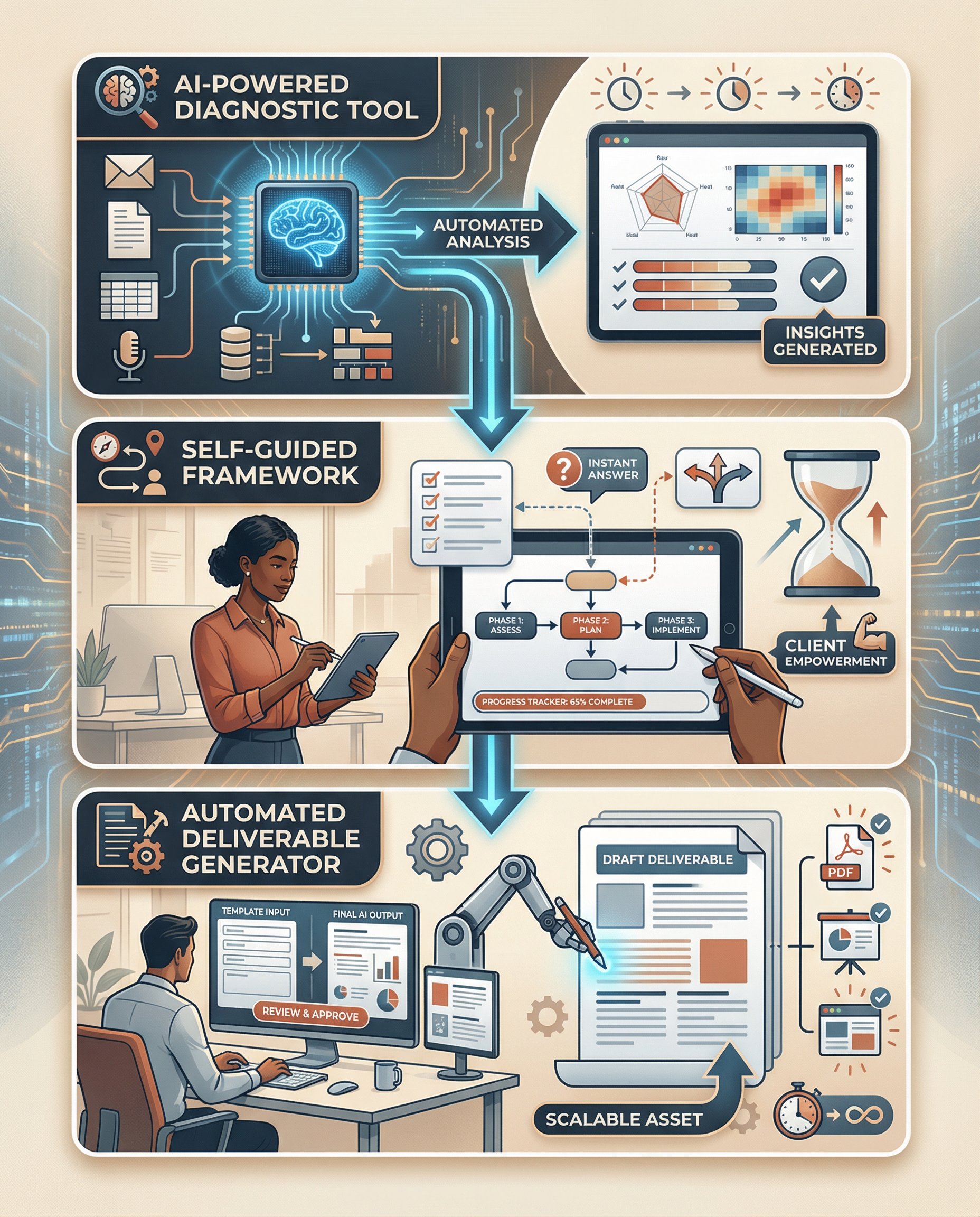
Asset Type 1: The AI-Powered Diagnostic Tool
Most good advisors begin an engagement with some version of a diagnostic — a structured discovery process that surfaces the client's real situation before recommendations are made. That diagnostic usually involves your expertise to interpret the results. But the data collection, initial categorization, and pattern-matching against your framework? That part can be automated.
An AI-powered diagnostic tool works like this: you build a structured intake questionnaire (which you probably already have in some form, even if it's just questions you ask on every kickoff call). You translate it into a form or a conversational interface. The AI processes the responses, maps them against your framework, and generates an initial findings summary — pre-formatted, categorized, and ready for your review.
What changes: instead of spending 60 to 90 minutes in a discovery call gathering basic information, you review a structured summary before the call and spend the whole session on the analysis and insight layer. You just took a 90-minute meeting and made it a 45-minute meeting with better output. Multiply that across ten clients per month and you've reclaimed hours of calendar time without reducing the quality of what you deliver.
Asset Type 2: The Self-Guided Framework
Your most-used consulting framework — the one you've applied across dozens of client situations — almost certainly has a self-guided version living inside it. The client questions you ask, the sequence of analysis steps, the decision points, the common patterns and what they indicate. All of that can be packaged into a structured tool that clients work through between your sessions.
This serves a few purposes. First, it moves prep work to the client. They arrive at each session having already done structured thinking. Second, it creates a consistent documented output that reduces your reporting time. Third, it extends your reach — clients who can't afford full retainer engagements can work with the framework independently, creating a lower-cost access point that builds relationships and pipeline without taking calendar time from your highest-value work.
Building this doesn't require a developer. AI tools can help you translate a framework that lives in your head (or in a scattered slide deck) into a coherent, formatted, usable tool in a fraction of the time it would take to build it manually.
Asset Type 3: The Automated Deliverable Generator
Here's where the time savings get significant. For most client engagements, a substantial portion of deliverable creation follows a predictable pattern. Status reports, summary documents, recommendations frameworks, implementation roadmaps — these have structures that repeat across clients. The specific content changes, but the architecture doesn't.
An AI-assisted deliverable system works like this: you define the template for each deliverable type based on your proven structure. When a deliverable is due, you input the client-specific data and findings. The AI generates a first draft in your format, using your language and your framework. You review, adjust, and add the nuance that makes it yours. What was a three-hour deliverable becomes a 45-minute review and refinement exercise.
| Deliverable Type | Old Time Per Client | With AI Workflow | Time Saved per Engagement |
|---|---|---|---|
| Diagnostic / Assessment Report | 4–5 hours | 1–1.5 hours | 3–4 hours |
| Monthly Status / Progress Summary | 90 minutes | 25–30 minutes | 1+ hour |
| Recommendations Memo | 3–4 hours | 60–75 minutes | 2–3 hours |
| Implementation Roadmap | 5–6 hours | 1.5–2 hours | 4 hours |
Now look at those numbers across a practice with five active client engagements. You're looking at 50 to 60 hours per month of deliverable creation time. Cut that by two-thirds and you've reclaimed 30 to 40 hours. That's the equivalent of a full work week — every single month — that can go back into business development, new service design, or just not working nights and weekends.
Making the Transition: From Time-Seller to IP-Owner
The mindset shift matters as much as the tools. Moving from hourly billing to scalable assets requires accepting that your value doesn't live in the number of hours you spend — it lives in the quality of your thinking and the proven reliability of your frameworks. Clients don't actually want your time. They want your results. The time is just the delivery mechanism they're used to paying for.
When you build systems that deliver your results more efficiently, you're not giving something away — you're upgrading the delivery mechanism. The IP is still yours. The insight is still yours. The framework is still yours. You're just letting smarter systems carry more of the administrative and structural weight so you can focus on the judgment layer that no AI will replace anytime soon.
Start with the deliverable type you produce most often. Map it out: what's the structure, what's the standard language, what changes per client, what stays the same. That's your first scalable asset. Build the template, run three engagements through it, refine it, and watch the time math change.
The Effect: What a Practice Built on Scalable Assets Actually Looks Like
Advisors who have made this transition describe a specific shift in how their practice feels. The pressure of utilization — the anxiety of "are my hours filled" — starts to ease when your revenue isn't 100% dependent on calendar availability. When some of your value is being delivered by Silent Workers and automated systems, a slow week on calls doesn't mean a slow week for clients.
More concretely, it changes what growth means. Instead of growth requiring more of your time, it can mean more clients served by better systems. A practice built on scalable assets can expand without the founder working proportionally more hours. That's Greater Freedom — not in the abstract sense, but in the measurable sense of taking August off without your revenue collapsing.
It also changes how you position and price. When your frameworks have been productized and systematized, they feel more substantial — because they are. Clients can see the IP. They can work with it. They understand they're not just getting your time; they're getting access to a proven methodology that's been tested and refined across many engagements. That's a different conversation than selling hours.
The advisors who are thriving in the current market aren't necessarily the smartest or the most experienced. They're the ones who figured out how to package what they know into systems that work independently — and then used AI to build and maintain those systems without adding administrative burden.
The Bottom Line
Hourly billing served you to get here. But it's not the model that gets you to where you want to go. Your IP — your frameworks, your diagnostics, your deliverable structures — is the most durable asset your practice has, and AI gives you the tools to let it work at scale. Smarter Systems don't replace your expertise. They amplify it, and they free you from the ceiling that has been holding your growth back.
Want to see exactly where AI can start reclaiming hours in your practice? Take the Freedom Audit — a simple, structured tool that shows you precisely where your billable and non-billable time is going. And if you want to see how other advisors are making the shift, join the community at The Elevate Effect, where the playbooks are shared openly.
Comments
Post a Comment