
TL;DR — The 60-second version
- Advisors win on information advantage — but the reading pile is impossible to clear by hand.
- AI doesn't replace your judgment; it processes 100-page reports in seconds and surfaces what matters for this client.
- Your job shifts from “read everything” to “know what questions to ask.”
- Build a repeatable summarization workflow and walk into every meeting genuinely prepared.
A new McKinsey report just dropped on your client's industry. Your inbox also flagged a 90-page regulatory analysis, a Gartner forecast you've been meaning to read, and the quarterly earnings transcript from the client's largest competitor. All of it is relevant. All of it could inform your advice. And none of it is getting read before your call tomorrow morning.
The advisory business runs on information advantage. Clients pay for your judgment, and your judgment is only as sharp as your understanding of what's actually happening in their market. The advisor who walks into a meeting having read the latest industry report — and synthesized the three most important implications for that specific client — is a fundamentally different advisor than one who shows up with general knowledge and good instincts.
The problem is volume. The sheer quantity of relevant information in most advisory domains has grown faster than any human's reading capacity. A serious healthcare consultant trying to stay current faces a genuinely impossible stack: FDA guidance updates, CMS policy changes, major health system earnings calls, trade publication analysis, academic research, and the category-specific intelligence their clients need. You can subscribe to every relevant publication and still drown.
This is the information problem that AI is uniquely well-positioned to solve. Not because AI understands the reports better than you do — but because AI can process the structural content of a 100-page document and extract what's relevant to your specific question in seconds, not hours. Your job shifts from “read everything” to “know what questions to ask.”
The Grind: the reading debt every advisor accumulates

Most advisors have a version of what I call the Reading Pile: a collection of saved articles, downloaded reports, bookmarked publications, and emailed PDFs that represents weeks or months of “I'll get to this.” It's not laziness. It's math. There are about 40 useful working hours in a week, and most of them are already allocated to actual client work. The reading that keeps you sharp gets pushed to nights and weekends, and even then, most of it never gets touched.
The downstream effect is subtle but real. You find yourself giving advice based on what you read 18 months ago. Your frameworks are solid but your market intelligence is dated. Clients start bringing you information they've read rather than the other way around. The information edge that made you a compelling advisor starts to erode.
This is a specific kind of Admin Debt — not the kind that piles up in inboxes and spreadsheets, but the intellectual kind. The cost of being behind on your reading isn't measured in hours lost to a specific task. It's measured in the sharpness of your advice and the confidence of your client conversations.
The AI summarization workflow that actually works
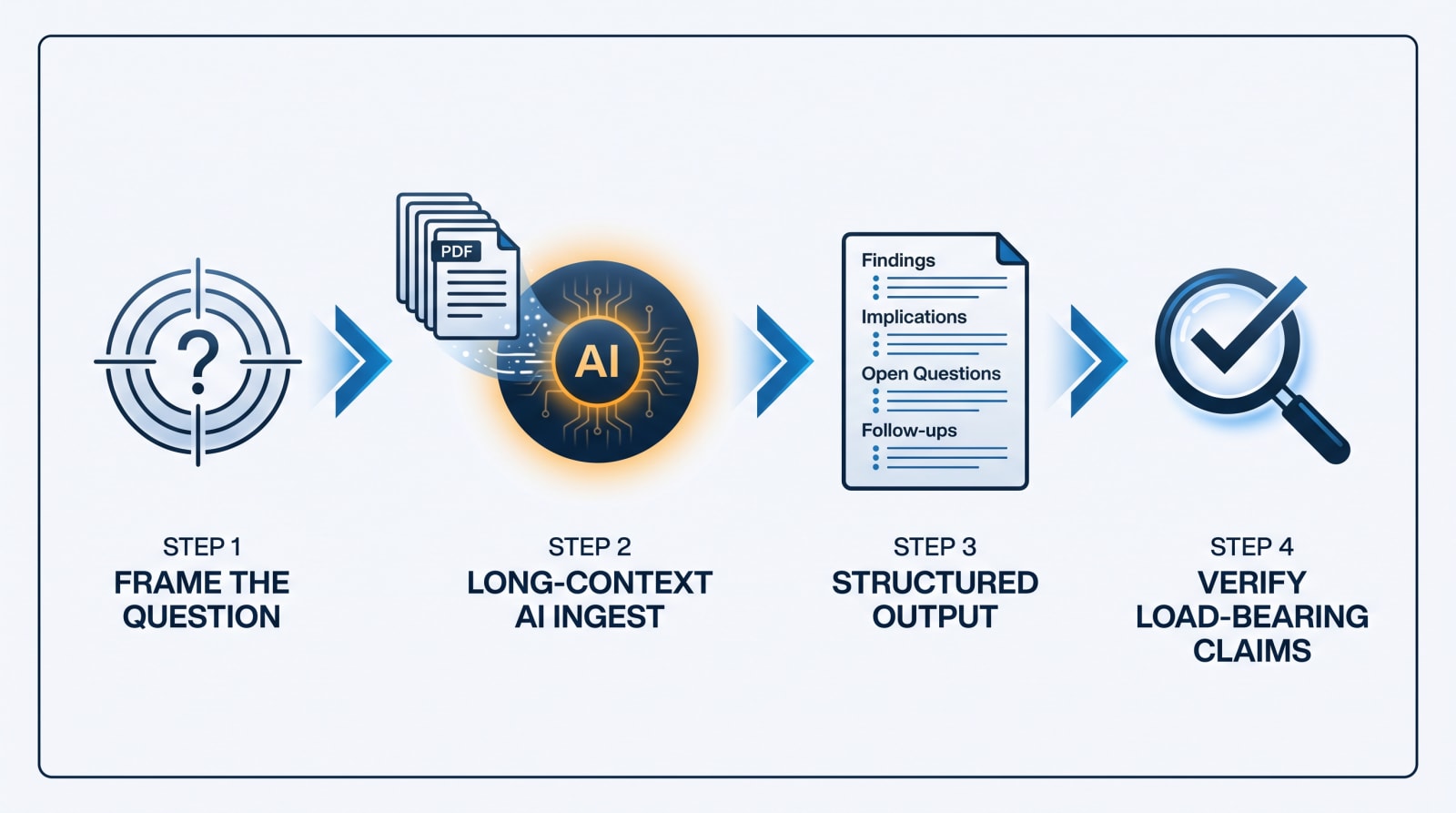
This isn't “paste a PDF into ChatGPT and pray.” A real workflow has four moves:
- Frame the question first. Before you upload anything, write the specific question you're trying to answer for a specific client. “What are the three implications of this CMS rule change for a 12-hospital health system in the Northeast?” beats “summarize this.”
- Use a model that handles long context. Claude, Gemini, and GPT-class models can ingest the whole document. Don't chunk it manually if you don't have to.
- Ask for structure, not prose. Request a brief in the format you actually use — key findings, implications, open questions, recommended follow-ups.
- Verify the load-bearing claims. AI is for the synthesis pass, not the source of truth. Spot-check the 2–3 facts your advice will rest on.
Before and after: the night-before-the-meeting test

| Prep task | Without AI | With AI workflow |
|---|---|---|
| 90-page industry report | 3–4 hours skim, never finished | 10-min targeted brief |
| Competitor earnings call | Skipped | Transcript → 3 client implications |
| Regulatory update | Read once, lost in inbox | Filed against active client list |
| Client-specific synthesis | Generic frameworks | Tailored to this client's situation |
Why this matters: the moments that justify retainers
The ability to connect an industry pattern to a specific client implication that a less-informed advisor would miss entirely — those are the moments that justify retainers. Not the big quarterly deliverables, but the consistent evidence that you're paying attention, staying current, and thinking about their situation with access to the best available information.
An AI-powered research stack makes those moments easier to deliver, more frequently, without requiring you to be a speed-reader with unlimited bandwidth.
Greater Freedom in this context looks like showing up to every meeting genuinely prepared — not because you sacrificed your weekend reading, but because your Smarter System prepared the brief while you were doing something else.
The bottom line
Information advantage is still a competitive edge in advisory work. The question is whether you build that edge through brute-force reading or through smart systems that process information at scale and surface what actually matters. AI-powered research workflows let you stay genuinely current across your market, show up sharper for every client meeting, and do it without the Reading Pile growing any taller.
The first step is knowing where your time is actually going.
The Freedom Audit shows you exactly where your hours are disappearing — including research and prep time that never quite happens — then join the advisors and consultants building these systems inside The Elevate Effect.
Join The Elevate Effect community
Or take the Freedom Audit Worksheet first.
Comments
Post a Comment