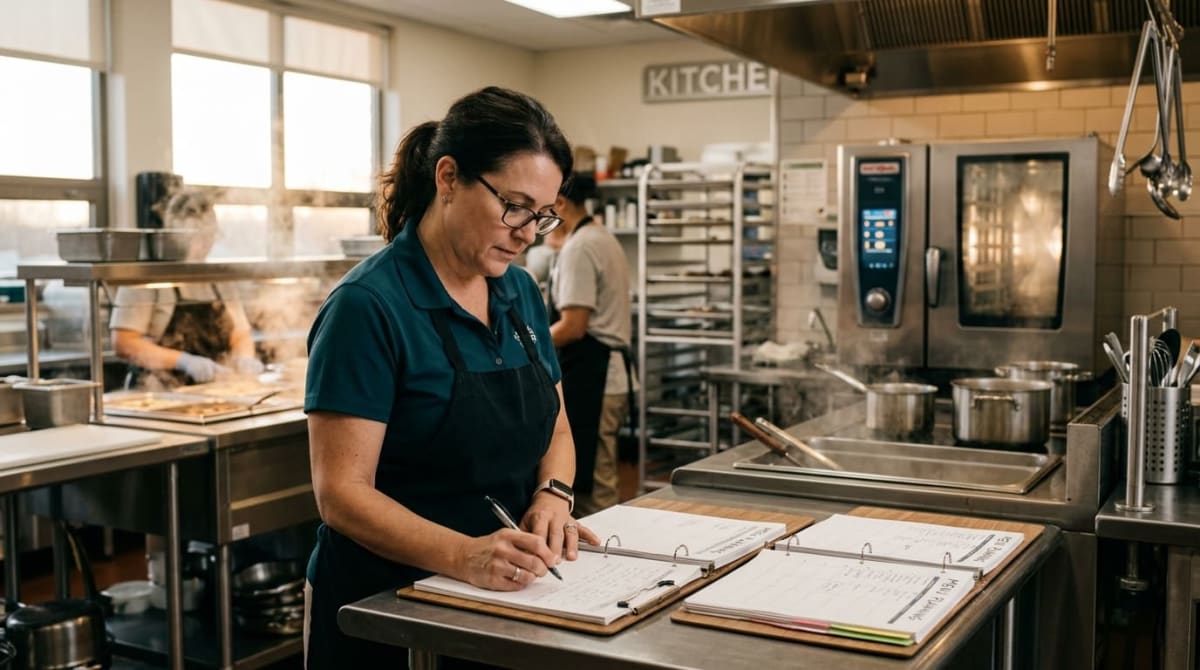
It's 5:40 a.m. on the Monday of startup week. The cafeteria lights buzz on one bank at a time, the walk-in compressor kicks over, and the office desk is already stacked: blank production record templates, a menu worksheet that still needs component counts, two half-finished substitute applications, and a sticky note that says the new combi oven never got commissioned. Nobody is thinking about AI for school nutrition at 5:40 in the morning. They're thinking about whether the milk order lands before Thursday.
If you run nutrition services for a district, this week is your Super Bowl and your tax season stacked on top of each other. The menus got finalized in July. Now comes everything else: onboarding staff who have never seen your serving lines, loading meal prices into the POS, answering parent emails about allergens and account balances, and reading the state agency's back-to-school memo before the deadline buried on page nine.
And if you're the dealer, consultant, or service agent on the other side of those schools, you're living the mirror image. Punch lists that have to close before the first bell. A tech rolling a truck to a steamer that sat unloved since June. This post is for both sides of that counter.
The short version: AI for school nutrition isn't robots on the serving line. It's Silent Workers, small AI systems running in the background, that draft daily production records from photos and voice notes, check menus against meal pattern requirements, write and translate parent messages, answer routine phone calls, and turn forty-page agency memos into one-page summaries. Directors running even two or three of these workflows report reclaiming 15 or more hours a week during the busiest stretch of the year. No coding. No new head count.
The Grind
Startup week has a rhythm, and the rhythm is paper.
Production records lead the list. Every serving day, at every site, someone documents what was planned, what was served, what was left. Multiply by four schools and 180 serving days and you've got a part-time job nobody posted. Then comes the compliance stack: meal pattern crosswalks by grade group, the carb counts the nurse asked for, temperature logs, and the certification paperwork your state wants updated any time the menu moves.
Staffing is its own morning ritual. A cook calls out at 5:15 and you're working the sub list from the parking lot, phone in one hand, keys in the other. The labor math in foodservice has been broken for years, and school kitchens feel it worst because the shift starts before sunrise and the pay scale is set by a board.
Add parent communication (allergen questions, account balances, help with free and reduced applications, often in two or three languages), state reporting deadlines, and an equipment list where the warranty paperwork from last spring's install is still riding around in somebody's truck. None of this is the job. All of it is attached to the job.
The Workflow
Here's what changes when you put Silent Workers on the paperwork. Pick one, run it for two weeks, keep what pays.
- Production records that draft themselves. Kitchen leads snap a photo of the line sheet or leave a sixty-second voice note at the end of service. An AI workflow transcribes it, drops the counts into your record template, and flags gaps: a missing leftover count, a component that doesn't match the posted menu. You review and sign. The record is still yours. The typing isn't.
- A menu compliance checker. Paste next month's cycle menu into an AI assistant and ask it to check components and portions against the meal pattern for each grade group, then list anything questionable for you or your dietitian to verify. A second set of eyes that never gets tired on a Friday afternoon.
- Parent messages in minutes. Draft the back-to-school letter once, then have AI produce the Spanish version, the short text-message version, and the website version. Same voice, same facts, four formats. When a parent emails about an allergen, an assistant drafts the reply from your own posted policies and you hit send.
- A phone line that answers itself. A voice agent can take the calls that repeat all August: serving times, application status, how to load a lunch account. If your front office phone rings all day, that's a solved problem in 2026, and it works just as well at 6 a.m. as it does at 6 p.m.
- Memos on a diet. Feed the forty-page state memo or the new federal guidance into a summarizer and get back the one page that applies to your district, deadlines pulled out and dated. We walked through the exact method in how to summarize industry reports in minutes.
If you sell to schools or service them
Dealers and service agents, the same tools work on your side of the counter. Service calls surge in August when equipment wakes up from summer break; a voice agent catching after-hours school calls means the steamer that's down at 6 a.m. gets triaged before your dispatcher's first coffee. And when a district asks ChatGPT which combi oven fits a K-8 kitchen before they ever call you, being the company with fast, clean spec answers is its own sales pitch.
The Effect
Here's startup week, hour by hour.
The old way:
- 5:40 a.m. Keys, lights, preheat, and a call-out on the voicemail.
- 9:30 a.m. Chase yesterday's production records from two sites.
- 1:15 p.m. Return six parent calls about applications.
- 3:00 p.m. Start the state memo. Get four pages in.
- 6:15 p.m. Type tomorrow's sub request. Again.
With Silent Workers running:
- 5:40 a.m. The coverage gap texted you at 5:20, and the sub list has already been called.
- 9:30 a.m. Records from all four sites drafted; you review and sign in twenty minutes.
- 1:15 p.m. The voice agent handled eleven routine calls; two are flagged for you.
- 3:00 p.m. A one-page memo summary is in your inbox, two deadlines already on your calendar.
- 4:45 p.m. You're on the line tasting Thursday's new entree.
Put honest numbers on it. Consolidating and correcting production records: 25 minutes a day per site, four sites, five days. That's a bit over 8 hours a week. Parent email and phone tag: 45 minutes a day, another 3.75. Menu and compliance paperwork: 2 hours. Memos and report prep: at least 1 more. Total: 15 hours a week, and that's a quiet week with no health inspection and no freezer down.
Fifteen hours is two full school days.
Directors who run these workflows don't work less, exactly. They work on food: coaching a new cashier through meal identification, walking the walk-ins, tasting the entree that 400 kids will vote on with their trays. We call the metric Hours Reclaimed, and school nutrition earns it back faster than almost any corner of foodservice because the paperwork is so structured. Structured is exactly what AI is best at.
Questions I get about AI for school nutrition
Can AI-drafted production records hold up in a review?
The requirement is that records are accurate, complete, and reviewed, and nothing says a human has to do the first draft. Treat AI as the drafter and your staff as the verifier who checks and signs, keep your normal audit trail, and run the process change past your state agency contact the same way you would a new software purchase.
How much does AI for school nutrition cost a district?
Less than most directors expect. The general-purpose assistants that handle summaries, letters, and menu checks run about $20 to $30 a month per seat. Configured workflows, like a voice agent or automated production records, are typically a one-time setup plus a modest monthly fee, which pencils out well against 15 hours a week of salaried admin time.
Where should a director start during back-to-school season?
Start with the task that steals your mornings, which for most directors is production record cleanup. Run the AI draft in parallel with your current process for two weeks, measure the minutes, and keep it if it wins. One workflow, proven, beats five started. The rest of the list will still be there in October.
The Bottom Line
The first bell rings whether your paperwork is done or not; smarter systems decide whether you meet it at the serving line or at the copier. Grab a free Freedom Audit and we'll map which of these workflows pays back first in your district, or pull up a chair in The Elevate Effect, where nutrition directors and the dealers who serve them trade what's working every week.
Comments
Post a Comment